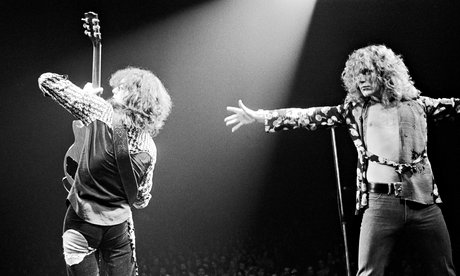
Paging Jimmy...
Courtesy of Radio.com
Jimmy Page: The Protector of Led Zeppelin’s Legacy and His Own
"I was there before the group started, and I know exactly what was recorded."
By Brian Ives
In 2012, Jimmy Page told Rolling Stone that his primary job these days is guardian of Led Zeppelin‘s legacy. The job, it turns out, has taken up much of his time in recent years, as Page has been remastering the band’s entire studio catalog, from 1969′s Led Zeppelin through the posthumous outtakes collection Coda.
“I was the authoritative one,” Page explained to Radio.com about his role as Zeppelin’s chief archivist. “I was there before the group started, and I know exactly what was recorded.”
The remastered albums are part of a massive reissue program that pairs each original Led Zeppelin album with a second disc of extra material. The discs will also come in “super-deluxe” editions packaged with lavish coffee-table books, including era-appropriate photos and other archival material. The reissue versions of Led Zeppelin, Led Zeppelin II and Led Zeppelin III hit retailers on June 3.
During his conversation with Radio.com, Page spoke about the critical slamming Led Zeppelin got during the band’s formative years, particularly from Rolling Stone. Every negative review aimed at Zep still stings and annoys him, seemingly more now than in 1969.
“If they only had a short time to review the album, along with three or four other albums, and this is their allotted [time] because they have to get their copy to print, well, of course they would have great difficulty” with an album like Led Zeppelin, Page seethed. “And because we weren’t in the singles market, where there’s an immediate point of reference all the time, by the time the third album comes out they’re going, ‘Well, they’ve gone acoustic, because Crosby, Stills and Nash are acoustic,’ or whatever. It’s just nonsense. But it’s quite amusing!”
Page laughs as he says this, but you get the distinct impression he still doesn’t actually find it amusing. He’s a serious man.
Page’s former bandmates Robert Plant and John Paul Jones might entertain a few questions about the band during interviews, and they’ll likely share a few memories with a guarded smile. But when they do, it’s clear that Zeppelin is very much in their rear-view mirror.
Related: Robert Plant says ‘zero’ chance of Led Zeppelin reunion
Page, by contrast, is deeply focused on the band, and will sternly correct any fact that is slightly out of place. Speaking with Page is a bit like the live version of “Dazed and Confused”: you can’t really be sure where it’s going to go, and it could get unexpectedly harsh and dangerous at any moment. Of course, therein lies the excitement.
~
Radio.com: Is this project the last word on the Led Zeppelin studio catalog? Are these the definitive version of the albums?
Jimmy Page: I’d like to think so, because I’ve mastered and remastered right across the board. I didn’t actually master for mp3 files, but [I did for] everything else! In actual fact, there’s even files that are super-duper hi-res for whatever format may come along.
You’re ready for whatever comes in 50 years.
Who knows! But what I do know, which is something that is very clear, is that you almost have to reassess how your music is being heard, and make sure you address whatever that is. That’s something I certainly have learned. There’s 20 years since the last remastering [for CD], there’s been so many changes in the way that people hear things. I’d call [the new remastering] a necessity.
A lot of your peers, and artists who came before you, didn’t think about their legacy, or how their music would be repackaged in 10 or 20 years. But a few years ago, you told Rolling Stone that you see yourself as the guardian of Led Zeppelin’s legacy.
I’m the knowledgeable one, you know? I was the authoritative one. I was there before the group started, and I know exactly what was recorded, and I had reference mixes from the studio dates that I did. I was in the studio more times than the others, because I was the producer, you see. That’s why I had such a cache, an archive of material to be able to sort of go through. I do know the history of the band, and I do know how things were recorded and for what they were recorded, whether for a live capacity or the studio albums. Yeah, there was a responsibility to the Led Zeppelin legacy, basically because I was there, and I didn’t really want to see it messed about with.
George Martin remembers more detail about the Beatles sessions than the members, I guess that’s part of being the producer.
It really is, it would be hopeless if you couldn’t remember, wouldn’t it? Actually, I knew I had a pretty good memory and recall, but I was surprised just how detailed my memory was across those decades.
What goes through your mind when you’re working on this kind of project? This sort of started when you began work on the Celebration Day live album.
Well, it sort of started because I wanted to archive all of the material that I had that was in analog form. So, I even had tapes of my own material, early songs that I did when I was still living with my parents. As it went through chronologically, it went through to the Yardbirds things, and it got to the point where the Led Zeppelin thing started to pop up. Around the time of the Led Zeppelin DVD [released in 2003], I had an idea, I won’t tell you exactly what it was, but it did involve these things, but nobody could understand it. Nobody could understand what it was that I was saying, that includes [my] management at the time. The idea sort of resuscitated for this [project].
I don’t know whether everyone does [their entire catalog] all at once. I don’t care. What I do know is, the companion discs to each of the albums give all this sort of insight to the recording, or at least the atmospherics, it shows the work that went into the studio masters as you know them. The alternative versions and different songs that have never been heard, it’s a wonderful portal, it’s a great window in. I knew it was a hefty task to do, but knew the fans would love it when it came out, and now it is out, so great! [He checks to make sure his phone is turned off.]
Everyone wants to know: what’s Jimmy Page’s ringtone?
[laughs] Actually, it’s the same as everybody else’s, it’s the old phone ring, so you never know if it’s your phone going off or anybody else’s. Bloody nuisance, innit?
Over the years we’ve had live albums, but precious few Zeppelin studio recordings that we haven’t already heard. What made you decide that you were okay with opening up the vaults?
I knew that within my archive and the tape collection that I had, there were some real gems. I thought, “Well, now enough time has passed to be able to present this type of project and complete it and know that it’s the right thing to do.” Purely because that whole area of the studio music hasn’t [been] readdressed like the live music has. So there’s two ways of doing it. There’s sort of going back to the multi-tracks and doing all of that, or the way that I saw it, was to revisit all of the tapes that were done as alternate mixes or guide tracks, backing tracks or early stages to revisit all of those, because it’s true and faithful to the time when the album was recorded. So if you have a whole bulk of things for Led Zeppelin III, it’s great because it’s a time capsule, that’s why it works, that’s why this thing has real substance to it. So if you go to the stuff for Physical Graffiti, it’s a time capsule for that.
Did you enjoy it – did you enjoy listening to stuff that you hadn’t heard in a long time?
It was really enjoyable. It was really good to hear the musicians, John Bonham, John Paul Jones, Robert Plant, and even Jimmy Page. All just flying, absolutely flying at an altitude… there was no other group at the time that were doing that. Or could. They just couldn’t. Yeah, it’s always wonderful to hear it.
Was there anything that you’d forgotten about?
With the detailed searching, believe me, I left no stone unturned. I was even checking out whatever had come out on bootleg that had leaked out of studios in the past – not by us, I might add. But I wanted to make sure that the material that I was going to present was not out already on bootleg. And that was a successful hunt, and it was obviously the right thing to do. I knew what I was looking for. And things would crop up. “Key to the Highway” [a bonus track on Led Zeppelin III], I remembered that we had done it, I didn’t remember that Robert started singing “Trouble in Mind” halfway through it, do you know what I mean? My recall [is] of the fact that I’ve got him set up singing through one of my amplifiers through the vibrato channel, and he was playing harp. I had a good recall of it. It was still a wonderful surprise to hear it. But it wasn’t like I didn’t know I recorded it. Nevertheless, the subtleties in it were wonderful and reassuring to hear, they were really charming, they were really quite magical.
The only thing that turned up that I’d literally forgotten about, out of all of these tapes and hundred and hundreds of hours of listening was: I had an early mix, a studio mix of Presence, and that had extra material on it. And that was the album I thought, with all of this chronological opening of everything, that might present a problem, and lo and behold, there it was. It was a deliverance.