Re: The Sound Of The Kinks
................
Breakthrough and American touring ban (1964–1966)
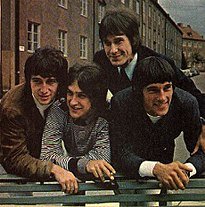
"You Really Got Me" (1964) features a jagged, distorted guitar riff, created by Dave Davies' mauling of an amplifier. The Kinks' first hit, it topped the British charts and reached number seven in the United States.
.
The Kinks' first single was a cover of the Little Richard song "Long Tall Sally". Despite the publicity efforts of the band's managers, it was almost completely ignored. When their second single, "You Still Want Me", failed to chart, Pye Records threatened to annul the group's contract unless their third single was successful.
"You Really Got Me" was released in August 1964, and, boosted by a performance on the television show Ready Steady Go!, quickly reached number one in the United Kingdom. Hastily imported by the American label Reprise Records, it also made the Top 10 in the United States. The loud, distorted guitar riff—achieved by a slice Dave Davies made in the speaker cone of his Elpico amplifier (referred to by the band as the "little green amp")—gave the song its signature, gritty guitar sound. Extremely influential on the American garage rock scene, "You Really Got Me" is regarded as the first hard rock hit and the blueprint for related genres, such as heavy metal. Soon after its release, the group recorded most of the tracks for their debut LP, simply titled Kinks. Consisting largely of covers and revamped traditional songs, it was released on 2 October 1964, reaching number four on the UK chart. The group's fourth single, "All Day and All of the Night", another original hard rock tune, was released three weeks later, reaching number two in the United Kingdom, and number seven in the United States. The next singles, "Set Me Free" and "Tired of Waiting for You", were also commercially successful, the latter topping the UK singles chart.
The Kinks amusing themselves during a Swedish tour in 1965The Kinks made their first tour of Australia and New Zealand in January 1965 as part of a package bill that included Manfred Mann and The Honeycombs. An intensive performing schedule saw them headline other package tours throughout the year with acts such as The Yardbirds and Mickey Finn. Tensions began to emerge within the band, expressed in incidents such as the on-stage fight between Avory and Dave Davies at The Capitol Theatre, Cardiff, Wales on 19 May. After finishing the first song, "You Really Got Me", Davies insulted Avory and kicked over his drum set. Avory responded by hitting Davies with his hi-hat stand, rendering him unconscious, before fleeing from the scene, fearing that he had killed his bandmate. Davies was taken to Cardiff Royal Infirmary, where he received 16 stitches to his head. To placate the police, Avory later claimed that it was part of a new act in which the band members would hurl their instruments at each other. Following a mid-year tour of the United States, the American Federation of Musicians refused permits for the group to appear in concerts there for the next four years, effectively cutting off The Kinks from the main market for rock music at the height of the British Invasion. Although neither The Kinks nor the union gave a specific reason for the ban, at the time it was widely attributed to their rowdy on-stage behaviour.
A stopover in Bombay, India, during the band's Australian and Asian tour had led Davies to write the song "See My Friends", released as a single in July 1965. This was an early example of crossover music and one of the first pop songs of the period to display the direct influence of traditional music from the Indian subcontinent. In his autobiography, X-Ray, Davies noted he was inspired to write "See My Friends" after hearing the songs of local fishermen during an early morning walk:
I remember getting up, going to the beach and seeing all these fishermen coming along. I heard chanting to start with, and gradually the chanting came a bit closer and I could see it was fishermen carrying their nets out. When I got to Australia I wrote lots of songs, and that one particularly.
Music historian Jonathan Bellman argues that the song was "extremely influential" on Davies' musical peers: "And while much has been made of The Beatles' 'Norwegian Wood' because it was the first pop record to use a sitar, it was recorded well after The Kinks' clearly Indian 'See My Friends' was released."
Pete Townshend of The Who was particularly affected by the song: "'See My Friends' was the next time I pricked up my ears and thought, 'God, he's done it again. He's invented something new.' That was the first reasonable use of the drone—far, far better than anything The Beatles did and far, far earlier. It was a European sound rather than an Eastern sound but with a strong, legitimate Eastern influence which had its roots in European folk music." In a widely quoted statement by Barry Fantoni, 1960s celebrity and friend of The Kinks, The Beatles, and The Who, he recalled that it was also an influence on The Beatles: "I remember it vividly and still think it's a remarkable pop song. I was with The Beatles the evening that they actually sat around listening to it on a gramophone, saying 'You know this guitar thing sounds like a sitar. We must get one of those.'" The song's radical departure from popular music conventions proved unpopular with the band's American following—it hit number 11 in the UK, but stalled at number 111 in the US.
"There were only a few bands that had this sorta really rough-sounding, what we used to call 'R&B' style in the Sixties. There were the Yardbirds, there was us, there was the Pretty Things, as well."
—Dave Davies, interview with the Austin ChronicleRecording began promptly on the group's next project, Kinda Kinks, starting the day after their return from the Asian tour. The LP—10 of whose 12 songs were originals—was completed and released within two weeks. According to Ray Davies, the band was not completely satisfied with the final cuts, but pressure from the record company meant that no time was available to correct flaws in the mix. Davies later expressed his dissatisfaction with the production, saying, "a bit more care should have been taken with it. I think [producer] Shel Talmy went too far in trying to keep in the rough edges. Some of the double tracking on that is appalling. It had better songs on it than the first album, but it wasn't executed in the right way. It was just far too rushed."
A significant stylistic shift became evident in late 1965, with the appearance of singles like "A Well Respected Man" and "Dedicated Follower of Fashion", as well as the band's third album, The Kink Kontroversy, on which session musician Nicky Hopkins made his first appearance with the group on keyboards. These recordings exemplified the development of Davies' songwriting style, from hard-driving rock numbers toward songs rich in social commentary, observation, and idiosyncratic character study, all with a uniquely English flavour. The satirical single "Sunny Afternoon" was the biggest UK hit of summer 1966, topping the charts and displacing The Beatles' "Paperback Writer". Before the release of The Kink Kontroversy, Ray Davies suffered a nervous and physical breakdown, caused by the pressures of touring, writing, and ongoing legal squabbles. During his months of recuperation, he wrote several new songs and pondered the band's direction.[40] Quaife was involved in an automobile accident, and after his recovery decided to step back from the band for much of 1966. Bassist John Dalton filled in until Quaife returned to the group at the end of the year.
"Sunny Afternoon" was a dry run for the band's album Face to Face, which displayed Davies' growing ability to craft gentle yet cutting narrative songs about everyday life and people. Hopkins returned for the sessions to play various keyboard instruments, including piano and harpsichord. He played on the band's next two studio albums as well, and featured on a number of their live BBC recordings before joining The Jeff Beck Group in 1968. The Kinks' next single, a social commentary piece, "Dead End Street", was released at the same time as Face to Face and became another UK Top 10 hit, though it reached only number 73 in the United States. Music scholar Johnny Rogan described it as "a kitchen sink drama without the drama—a static vision of working class stoicism". One of the group's first promotional music videos was produced for the song. It was filmed on Little Green Street, a small 18th-century lane in North London, located off Highgate Road in Kentish Town.
.............................

 But the older I got, the further back my musical repertoire/appreciation went (I'm sure that many know of what I speak). The Kinks were the original punk band....without all of the punkishness (is that even a word?!?!) On my list of favorite British invaders, the Kinks take the #3 spot.

 ***:
***: